Public relations is often treated as a separate communications function. Business development handles prospects, partnerships, and opportunities. Sales handles conversations and proposals. Marketing manages visibility.
That separation creates a problem.
If your public visibility has no connection to the accounts, industries, and relationships you want to develop, PR may generate attention without creating useful momentum. At the same time, your business development team may be reaching out to prospects who have never heard of your company or understood why your expertise matters.
Public relations should support business development by making important conversations warmer, clearer, and more credible. Media coverage, executive visibility, thought leadership, project stories, events, and reputation all influence how potential customers and partners evaluate your organization.
PR doesn’t replace outreach. It gives outreach more context.
The problem with keeping PR and business development separate
Many organizations measure PR by activity:
- How many press releases were issued
- How many media pitches were sent
- How many impressions were reported
- How many social posts were published
These numbers can be useful, but they don’t explain whether PR is helping the business move forward.
A contractor may receive coverage in a trade publication, but does that coverage reach general contractors, developers, or facility managers the company wants to work with? A nonprofit may gain local attention, but does that visibility help attract donors, volunteers, or community partners? An engineering firm may publish technical insights, but are those insights reaching project owners and referral sources?
The better question is:
Does your PR activity make it easier for the right people to notice, trust, and choose your organization?
The U.S. Chamber of Commerce describes public relations as a way to build awareness, shape public perception, and communicate with important audiences. That makes PR relevant to business development when the audience and message are connected to growth priorities.
Reframe PR as relationship support
PR is not only about getting your name in the news. It is about shaping how your organization is understood by the people who influence your future.
That includes:
- Prospective customers
- Target accounts
- Referral partners
- Industry associations
- Community leaders
- Employees and candidates
- Investors and donors
- Journalists and event organizers
When these audiences encounter your company through credible coverage, useful commentary, or visible expertise, your outreach starts from a stronger position.
A prospect who has seen your executive quoted in a trade publication may be more open to a conversation. A property developer who has read about your completed project may have more confidence in your capabilities. A potential nonprofit partner who sees consistent community involvement may be more willing to explore collaboration.
This is why Strategic Communications & Public Relations should be connected to the same goals as marketing and business development.
Use media coverage to support target-account outreach
Media coverage is most valuable when it reaches the people you want to influence.
Before pursuing a story, identify the audiences that matter to your business development strategy. For example:
- Construction and industrial firms: Focus on trade publications read by general contractors, owners, procurement teams, and project managers.
- Professional services firms: Look for outlets that reach executives, referral partners, and industry decision-makers.
- Nonprofits: Prioritize local media, civic publications, and community channels that reach donors, volunteers, and institutional partners.
- Hospitality and local businesses: Consider regional publications, local news, tourism outlets, and event-related media.
Then connect the coverage to outreach.
If your company is featured in an article, share it with selected prospects who would find the topic relevant. Use it as a reason to reconnect with a dormant contact. Include meaningful coverage in a proposal when it reinforces your expertise. Add it to a capability presentation or sales follow-up sequence.
The goal isn’t to send every article to everyone. The goal is to use relevant coverage at the right stage of a relationship.

Make executive visibility useful
Executive visibility works best when it reflects real expertise rather than personal promotion.
Your leaders should have clear points of view on the issues their customers and partners are already considering. That might include:
- Safety and workforce challenges in construction
- Infrastructure investment and project delivery
- Changes affecting local businesses
- Community development and nonprofit funding
- Sustainability in architecture and engineering
- Hospitality trends and changing customer expectations
A strong executive visibility program can include interviews, contributed articles, conference panels, podcasts, commentary, and speaking opportunities.
Each appearance should answer a practical question:
What can your executive explain better than most people in the market?
When the answer is clear, visibility becomes more useful to business development. Your team can reference the executive’s perspective in conversations, proposals, presentations, and partnership discussions. It gives prospects a clearer understanding of how your organization thinks, not just what it sells.
Thought leadership also helps reduce perceived risk. Buyers want evidence that a potential partner understands the problems behind the assignment. Useful insight can provide that evidence before a formal sales conversation begins.
Turn project stories into business development assets
Completed work often contains valuable proof, but many organizations leave that proof buried in internal files.
A project story can support PR, sales, proposals, recruiting, and partnership development at the same time.
Build a project story around:
- The challenge: Explain the situation or problem the client faced.
- The approach: Describe the thinking, coordination, or process involved.
- The result: Show the measurable or practical outcome when information can be shared.
- The lesson: Identify what the project says about your organization’s expertise.
Avoid confidential information and unsupported claims. A useful project story doesn’t need to disclose every detail. It needs to show how your organization approaches important problems.
You can then adapt the story into a media pitch, case study, website page, proposal section, event presentation, social post, or follow-up email. This is where Content & Creative Production can support broader business development goals.
Connect events and partnerships to follow-up
Events create visibility, but the value often depends on what happens afterward.
A trade show, conference, community event, or speaking opportunity should have a clear follow-up plan. Before the event, identify the accounts, partners, journalists, and organizations you want to meet. During the event, gather useful conversations and content. Afterward, continue the relationship.
Your follow-up may include:
- Sending a relevant article or project story
- Sharing event recap content
- Introducing a potential partner
- Scheduling a more focused conversation
- Inviting a contact to a future event
- Connecting a prospect with an executive or subject-matter expert
Use Events, Partnerships & Community Engagement as part of a larger relationship strategy, not as a collection of isolated appearances.

Measure PR by business development signals
PR shouldn’t be reduced to vanity metrics, but it should be measured against business priorities.
Track indicators such as:
- Target-account engagement: Did priority companies visit your website, respond to outreach, or interact with relevant content?
- Qualified conversations: Did coverage or thought leadership contribute to meetings with the right prospects?
- Proposal influence: Was PR content used in proposals, presentations, or qualification materials?
- Partnership opportunities: Did visibility lead to introductions, referrals, speaking invitations, or collaborations?
- Search and website behavior: Did branded searches, relevant page visits, or referral traffic increase?
- Pipeline movement: Did a contact progress from awareness to conversation, opportunity, or proposal?
These signals won’t always create a perfect line between one article and one closed deal. Business development is often a long process involving several interactions.
Still, you can improve visibility by recording where prospects heard about you, which content they reference, and what influenced their decision to engage. Business Development Support becomes more effective when outreach is supported by credible proof and consistent communication.

Build one connected system
Public relations should not sit on the sidelines while sales and business development operate independently.
Start by aligning your PR priorities with your growth priorities. Identify the industries, accounts, partnerships, and relationships that matter most. Then create visibility that helps those audiences understand your expertise and trust your organization.
A practical system may include:
- A target-account media and outreach list
- A quarterly thought leadership calendar
- A project-story development process
- Executive messaging guidelines
- Event and partnership follow-up plans
- Shared reporting between PR, marketing, and business development
This approach makes PR more useful and business development more credible.
Public relations may not create an immediate opportunity every time your organization receives coverage or publishes an insight. Its value builds through repeated exposure, stronger reputation, and better-informed conversations. Over time, those advantages can help your organization get noticed, earn consideration, and enter opportunities with greater credibility.
PR works best when it supports the relationships that drive growth.
SEO and editorial details
Primary keyword:
How public relations supports business development
Supporting keywords:
- PR and business development
- B2B public relations
- Public relations strategy
- Media coverage for business growth
- Executive visibility
- Thought leadership
- Reputation management
- Business development outreach
- PR measurement
- Earned media
SEO title:
How Public Relations Supports Business Development
Meta description:
Learn how media coverage, executive visibility, thought leadership, events, and reputation can support business development and create warmer opportunities.
Category:
Public Relations & Media
Internal-link recommendations:
- Strategic Communications & Public Relations
- Business Development Support
- Content & Creative Production
- Events, Partnerships & Community Engagement
Credible external sources:
- U.S. Chamber of Commerce: A Guide to Public Relations for Small Business
- Business Queensland: Public Relations
- Forbes Business Development Council: Benefits of Working With PR Agencies
Featured-image concept:
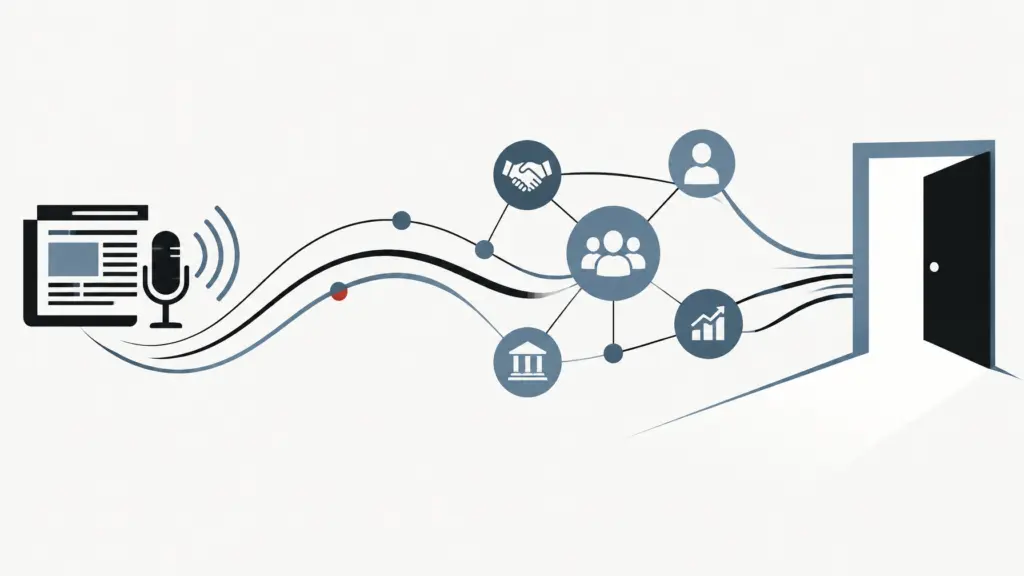
A minimalist geometric illustration showing media visibility flowing through connected relationship lines toward target accounts and business opportunities. Use Freeform’s black-and-white visual style with soft gray-blue structure and a restrained red accent.
Featured-image alt text:
Abstract illustration showing public relations visibility connected to business development opportunities.
Article type:
Thought leadership and practical strategy guide.
Research basis:
General research into public relations, media relations, executive visibility, reputation, thought leadership, and B2B business development, supported by the external sources listed above.
Suggested publication date:
October 15, 2026