
GEO for Authors: How to Make Your Book Discoverable by AI Assistants
For years, the path to being found as an author was simple: rank on the first page of Google. If you optimized your website for the right keywords, readers would eventually find your book. But the landscape has shifted. Today, your readers aren’t just typing queries into a search bar; they’re asking AI assistants like ChatGPT, Claude, and Perplexity for recommendations.
If you ask ChatGPT for “the best new sci-fi novels about climate change,” it doesn’t give you a list of links. It gives you a synthesized answer. If your book isn’t part of that answer, you don’t exist in that reader’s journey. This is the new reality of Generative Engine Optimization (GEO).
The Problem: Traditional SEO is No Longer Enough
The traditional playbook for an SEO strategy agency for writers used to focus almost exclusively on “blue links.” You’d target high-volume keywords, build backlinks, and hope to climb the rankings. While that still matters for traffic, it doesn’t solve the “AI discovery” problem.
AI models don’t “rank” websites in the traditional sense. They “cite” sources. When an AI generates a response, it pulls from a massive training set or searches the live web to find the most authoritative, clear, and relevant information. If your author platform is a mess of unstructured blog posts and vague descriptions, the AI will bypass you for a source that is easier to digest.
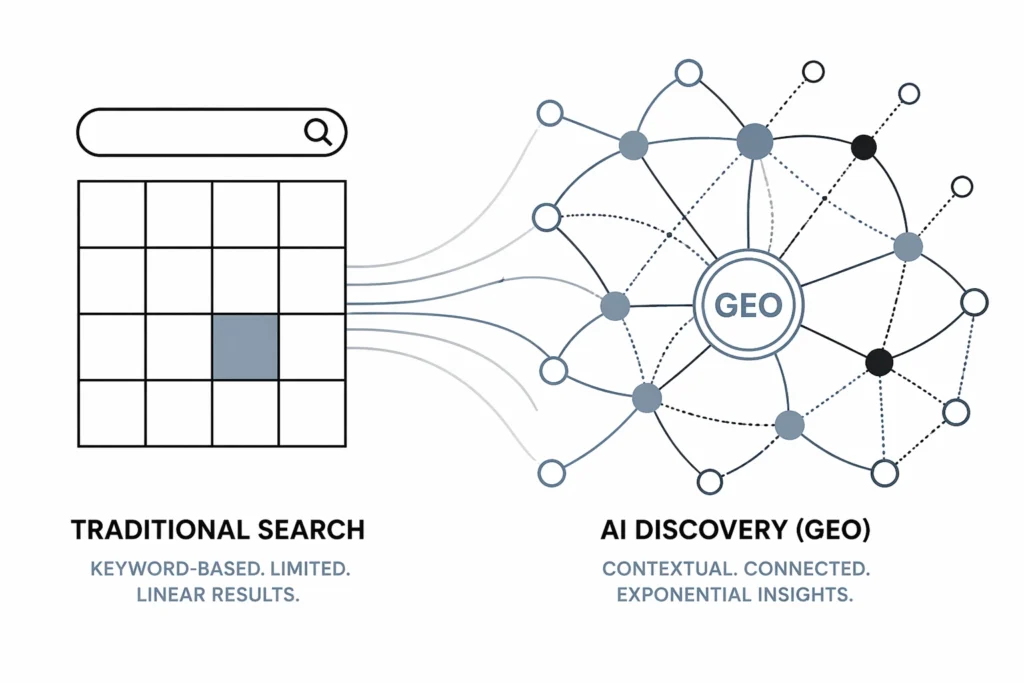
The Reframe: From Ranking to Citation
To succeed in 2026, you have to stop thinking about how to get a human to click a link and start thinking about how to get an AI to trust your data. You need to move from being a “result” to being a “source.”
AI models prioritize authority and clarity. They look for content that is structured in a way that’s easy to extract. When you optimize for GEO, you aren’t just trying to be seen; you’re trying to be the foundation of the AI’s answer. This requires a shift in how you present your brand identity and your book’s digital footprint.
Practical Steps to Master GEO
If you want your book to be discoverable by AI assistants, you need to change your technical and creative approach. Let’s take a closer look at how to do that.
1. Prioritize Structure and Hierarchy
AI models love clear hierarchies. Use H1, H2, and H3 tags effectively on your book landing pages. Don’t just write a 500-word block of text for your book description. Use bullet points for key themes, numbered lists for chapter highlights, and clear subheadings for your author bio.
Pages with structured lists and statistics see a significant increase in visibility in AI responses. If an AI can scan your page and quickly see “5 Key Takeaways from [Book Title],” it is much more likely to include those takeaways in a generated answer.
2. Implement Schema Markup
This is the technical “handshake” between your website and AI models. Use Author Schema and Book Schema to tell search engines exactly who you are and what you’ve written. This structured data helps AI assistants connect the dots between your name, your genre, and your specific titles. If you’re unsure where to start, looking into SEO strategies for small businesses can provide the technical foundation you need.
3. Maintain Content Freshness
AI engines have a strong recency bias. Content that hasn’t been updated in months is often seen as less relevant. Update your author page regularly. Even if you haven’t released a new book, update your “About” section, add recent interview links, or refresh your bibliography with new “Last Updated” timestamps.
4. Create “Answer-First” Content
When writing blog posts or articles related to your book’s topic, lead with the answer. If your book is about “How to Start an Urban Garden,” your accompanying blog posts should answer specific questions: like “What are the best plants for small balconies?”: immediately. Put the core information at the top. Don’t bury the lead.
Why This Matters for Your Long-Term Growth
The goal of our marketing and branding services is to ensure your business: or in this case, your book: is positioned for maximum visibility. GEO isn’t a fad; it’s the natural evolution of how information is consumed.
By focusing on GEO now, you’re future-proofing your career. You’re ensuring that as more readers move away from traditional search and toward AI assistants, your work remains at the center of the conversation.
Ensure your site is structured for AI.
Maintain your authority through regular updates.
Include schema markup on every book page.
Start thinking like a source, not just a search result. The opportunities are there: you just need to make sure the AI knows where to find you.

